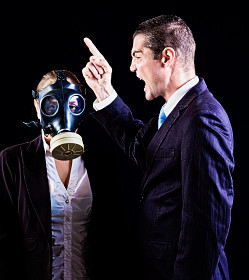
 I have had several management level jobs in my career where from my point of view, people were targeting me unnecessarily with anger and bad motives. At first, anger was my response but I soon realized that anger did not go very far in working out the situation to a profitable end. How was I to separate myself from anger so that I could resolve the issue with the person who was angry with me?
I had to come to realize that in almost all cases, I couldn’t take what the person was saying about me or the job that I was doing personally. It can be very hard to control yourself long enough to shift gears and come to that mindset. It takes practice.
Years ago, when I was first employed after college, I worked as a PR person for a large utility company in the Northwest. Anytime there was a complaint in my district, one of the Energy Consultants would have to resolve the issue by personally going to the home or business to assess the customer’s complaint. Many times the customers would be very hostile because it was money coming out of their pocket. These were my favorite calls because we were able to be detectives and find where the problem was in their account. My job was to find the problem and communicate to them what I had found in a calm, coherent manner.
One of the tools that I used was a training course in interviewing and PR that was created by the Xerox Company. In it, we would learn how to ask open-ended questions to get the person to talk about the problem. We would agree with their assessment of the situation (I can understand how you might feel that way) and then ask an open-ended question (Why do you feel that it is the company’s fault?). Getting the person to talk always lowered the temperature in the room.
We need to remember that if something is real to a person we must acknowledge that and then find out if it is truly a correct perspective. That in itself brings down the hostility within the conversation.
Many times when they raised their voices at me, I had to realize that they weren’t mad at me per se, they were mad because something was out-of-the-ordinary in their bill.
Many times when our relationships go awry, it is because someone perceives that something out-of-the-ordinary is happening in the relationship. That person may not know how to respond to that and it becomes our responsibility to respond in a proper way. If you take the personal out of it, you can respond in a much calmer tone and truly help the person talk about what is on their mind. It takes practice and courage to take the first volley of anger.
Lee Iacocca is quoted as saying, “In times of great stress or adversity, it’s always best to keep busy, to plow your anger and your energy into something positive.” What could be more positive than checking our anger at the door and to help someone understand a situation better or that we come to a better understanding of the the situation?
We must remember that most people aren’t angry at a person, they are angry at a situation. If we get angry, the person can shift their animosity from the situation to the person and then it will become increasingly difficult to succeed in resolving the heated issue.
Thing to remember:
1. People are usually mad at the situation not at the person.
2. Try to agree with their statement of frustration so you can ask an open-ended question so they will start to communicate with you.
3. Check your anger at the door and stop blaming. Fix the problem; don’t blame.
It takes practice and courage to get better at resolving relationship problems. The first step is to not take it personally.

 talk is cheap